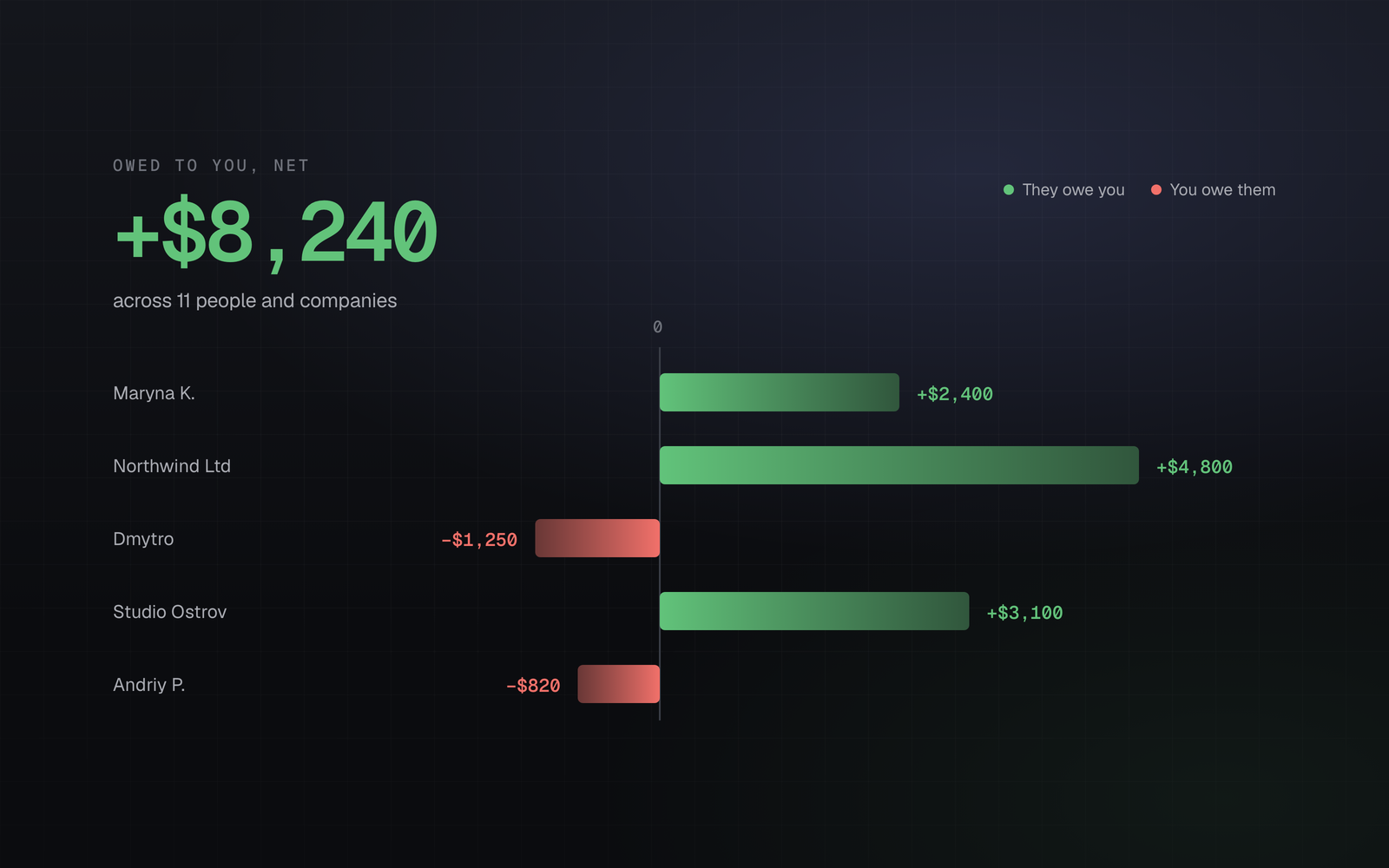
Almost nobody keeps a ledger for the people in their life, and almost everybody keeps one badly in their head.
You covered the deposit on the flat and your flatmate is paying you back in pieces. A client paid a retainer in March that is being drawn down against work. Your brother borrowed money in a bad month two years ago and neither of you has mentioned it since. A contractor invoiced for more than you agreed, you paid the agreed amount, and the difference is technically still open.
None of these are disputes. They are ordinary, and they go wrong in the same way: two people carry slightly different mental balances, nobody wants to be the one who brings it up, and after a year the difference between the two versions is larger than either party's confidence in their own.
The fix is unglamorous. It is a running balance per person, updated when money moves, visible to whoever needs to see it.
When a running balance is the right shape
Not every relationship needs one. Three situations genuinely do.
Ongoing informal debt. Money lent to family, a shared deposit, one person always paying for the group. The amounts are usually small enough that nobody writes a contract and large enough that people remember them wrong.
Retainers and deposits. A client pays $6,000 up front and you bill against it. At any moment there is a real number — how much of their money you are still holding — and both sides need to agree on it. This is where "I thought that was covered by the retainer" comes from.
Recurring trade with a counterparty. A subcontractor you work with monthly, a supplier on account, a landlord with a deposit. Individual invoices come and go; what matters between you is the net position.
In all three, the useful object is not a list of transactions. It is a balance with a sign.
A transaction list is not a balance
You can, in principle, reconstruct what someone owes you by filtering your records to that person and adding up the amounts. In practice this fails for a reason that is easy to miss: not every transaction with a person changes what they owe you.
Say a client owes you $3,000 and pays it. Money arrives, and you now have income of $3,000 and a balance that has gone to zero. Both facts are true, and they are different facts. Now say the same client pays you $3,000 as a deposit on next quarter's work. Identical bank row, identical amount — but this time you owe them $3,000 of work, and the balance moves the other way.
The bank cannot tell these apart. Nothing in the transaction itself distinguishes them. The only thing that does is your intent at the moment you record it, which means the tool has to ask, and you have to answer.
Two identical rows, same client, same amount. One means they no longer owe you anything; the other means you now owe them a quarter of work. Nothing in the transaction can tell you which.
Why the tool has to ask
So each transaction involving a counterparty needs one extra field, with three possible values:
- Deposit — this increases what you are holding for them, or reduces what they owe you.
- Charge — this increases what they owe you.
- Neither — a plain sale, settled on the spot, with no standing position either way.
Three options, one click, at the moment you have the context. Getting this field is the entire difference between a person's balance that is trustworthy and one that is a rough guess derived from a filtered list.
The sign convention that decides everything
Pick one and write it down, because half the confusion in this area is two people using opposite conventions without realising it.
The one we use: positive means they are ahead of you — you are holding their money, or you owe them. Negative means you are ahead — they owe you. It reads naturally from the counterparty's point of view, which is the view you will be in when you are talking to them.
The opposite convention is equally defensible, and mixing the two within one set of records is how you end up confidently telling someone they owe you money that you in fact owe them. Choose, be consistent, and label the number in words as well as sign wherever it appears.
Date the balance, not just the amount
"They owe me $400" is much less useful than "they have owed me $400 since 14 March". Age changes the meaning entirely: a balance from last week is a normal part of doing business, the same balance from two years ago is a decision you have been avoiding. Any counterparty view worth having shows the age of the oldest open item, not just the total.
When one balance per person is not enough
Sometimes a single running total genuinely cannot express the relationship.
A contractor might have an ordinary invoice balance and a separate equipment advance that is being repaid over six months. Netting them into one number destroys real information — the advance is being repaid on a schedule and the invoices are not, and combining them makes both untrackable.
The general answer is named side balances: a main balance plus, where needed, additional named ledgers under the same person, each with its own running total, each summing into the overall position. "Main" plus "Equipment advance" plus, for people you employ by the hour, an accrual ledger where unbilled time accumulates before it becomes an invoice.
The rule for when to create one: split into a separate ledger when the two balances would be settled by different events. An invoice balance clears when they pay an invoice; the advance clears on its own schedule. Different clearing events, different ledgers. Same clearing event, one balance.
The currency trap
If you lend €2,000 and are repaid in dollars, what were you repaid?
There is no universally correct answer, only a choice you have to make explicitly. Either the debt is denominated in euros — in which case a dollar repayment is a conversion, and the rate on the repayment day determines whether it settled fully — or the debt is denominated in dollars at the rate on the day you lent it, in which case the euro figure was only ever a description.
Say which, in writing, at the moment the debt is created. It costs one sentence then and prevents an unpleasant conversation later, because in the absence of an agreement both parties will remember whichever interpretation favours them, entirely honestly.
For this reason accrual balances in Capital Wizard are held per currency rather than converted into one figure: a person can be owed 1,400 EUR and 900 USD, and those stay two facts. Converting them into a single number would make the display tidier and the underlying position less true.
What this replaces
| Approach | Works until | Fails because |
|---|---|---|
| Remembering | About three months | Both parties remember favourably, and honestly |
| A note on your phone | The first repayment | Nobody updates it; no running total |
| Messages, searched later | The relationship stays simple | Amounts are scattered across a year of chat |
| A shared spreadsheet | Someone stops opening it | Requires both people to maintain it |
| A balance per counterparty | Indefinitely | — |
The reason to do any of this is not distrust. It is the opposite: a written balance is what lets you stop keeping score in your head, which is the part of an informal debt that quietly costs a relationship something. Once the number exists somewhere neutral, neither of you has to be the one who remembers it.
See your own number instead of reading about someone else’s.
Import a statement, add your accounts, and get a real net-worth figure in an evening. One month free, no card required.
Start free